
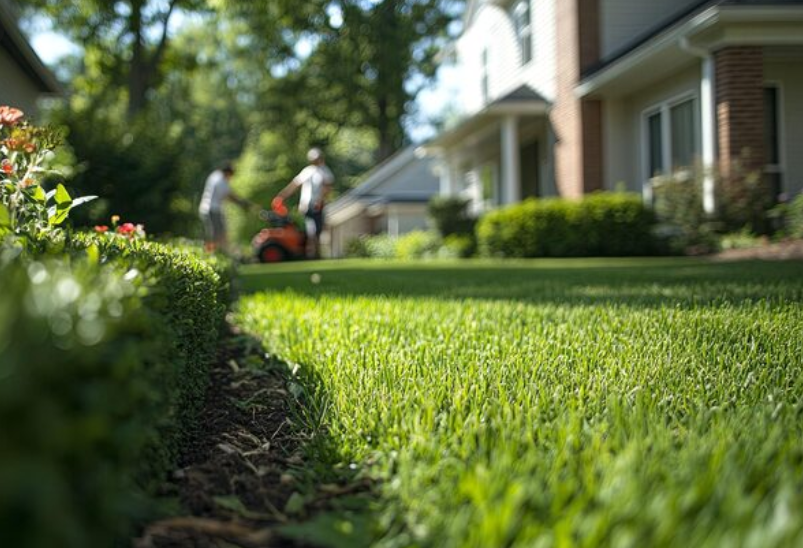
Weather gets blamed for most lawn damage and deserves a share of it. Drought browns turf in July, downpours wash seed off slopes in September, and freeze and thaw cycles heave grass crowns out of the ground all winter. What gets overlooked is that two lawns on the same street with the same weather often end up in different conditions by spring. The variable is below the surface. Residential lawn aeration changes the soil a lawn grows in, and soil determines how much of the weather reaches the plant.
Shallow Roots Are the Common Failure Point
Almost every weather-related lawn problem traces back to root depth.
Compacted soil stops roots from pushing downward, so they spread sideways in the top inch or two. That shallow layer dries fastest, heats up most, freezes first, and saturates soonest, so a lawn rooted only there has no buffer against anything.
Grass with roots running six inches down draws water and holds position in soil that stays cooler in summer, warmer in winter, and steadier in moisture. Nothing about the weather changed. The plant moved into conditions where the weather affects less.
Aeration makes that possible. Opening channels through the compacted layer gives roots somewhere to go, and roots follow the path of least resistance.
Summer Drought & Heat Stress
The pattern in a dry July is familiar. Grass goes from green to gray-green to brown in about a week, and it usually starts on slopes and in areas that get full afternoon sun.
Shallow-rooted grass draws from a very small reservoir. The top two inches of a compacted lawn hold little water and lose it quickly to evaporation and runoff, so when rain stops the supply runs out in days.
Compacted soil worsens the problem from the other direction too. Water applied to hard ground puddles and runs off, so a homeowner can run sprinklers regularly and deliver very little to the root zone. Aerated soil takes water down where it stays available.
Deeper roots also reach cooler soil. Surface temperatures on an exposed lawn in August can climb high enough to stress crowns directly.
Heavy Rain & Runoff
Northeast storms have grown less predictable, and the amount of rain falling in short bursts causes problems that steady rain does not.
Compacted ground has almost no infiltration capacity. Water arriving faster than the soil absorbs it moves across the surface, carrying topsoil, fertilizer, and seed with it. On a sloped lawn, the material a homeowner paid for ends up in the street.
Aeration holes work as entry points. Water finds them and moves down rather than across, which cuts runoff and keeps applied materials in place. The same channels reduce standing water in low areas.
This matters most in the weeks right after seeding, when one heavy storm can relocate an entire application of seed.
Freeze & Thaw Cycles in Winter
This region cycles above and below freezing repeatedly through winter rather than staying frozen, and that repetition does real damage.
Water in saturated soil expands as it freezes, lifting the surface, and settles again on thaw. Repeated across a season, that heaving pushes shallow grass crowns partly out of the ground, where they dry out and die. Deeply rooted turf stays anchored through the same cycles.
Drainage is the other half. Soil holding standing water going into a freeze heaves more than soil that drained, and aeration improves drainage ahead of winter.
Compacted soil also freezes deeper and stays frozen longer, which delays spring green-up.
Snow Mold & Spring Recovery
Snow mold develops under prolonged snow cover, particularly where grass went into winter too long or where leaves were left on the lawn. It shows up in spring as matted, straw-colored patches.
Soil conditions influence how much appears and how fast the lawn recovers. Ground that drains well dries sooner once snow melts, shortening the window the fungus has to work in, and turf with established roots pushes new growth through damaged areas faster.
Recovery is where the difference shows. A dense, deeply rooted lawn fills mold patches on its own within a few weeks of green-up, while a thin lawn leaves them open long enough for crabgrass to claim them.
How Open Soil Buffers Temperature Swings
Soil temperature moves more slowly than air temperature, and the deeper you go the slower it moves. That lag protects roots that reach it from the swings happening above.
Aerated soil also holds more air, and air conducts heat poorly. Ground with reasonable pore space moderates temperature better than dense soil with the air pressed out of it.
Two-direction coverage doubles the channel count through the compacted layer, which matters more on the clay-heavy soil across the Merrimack Valley than it would on sandier ground. Companies working in this region run it as standard for that reason, Stateline LawnCare in Haverhill is among them.
Soil type is why the same service produces different results in different places. Sandy ground drains and recovers on its own to a degree clay never does, so a single pass can be adequate where soil is loose and inadequate where it is not. Homeowners weighing national advice against local recommendations are usually seeing that difference rather than a disagreement about method.
What Aeration Cannot Protect Against
Being accurate about limits is worth more than overselling. Aeration will not prevent damage from road salt, plow scraping, or ice sheets that suffocate turf over a long winter. It does not stop snow mold from forming. It cannot make grass survive in an area receiving under about four hours of daily sunlight, and it does not correct a drainage problem caused by grading rather than compaction.
What it does is remove one of the main reasons ordinary weather causes lasting damage.
Building Weather Resilience Over Several Seasons
Root depth is not built in a single season. A lawn aerated once has more open soil than before, but the roots growing into it need time.
Properties aerated three consecutive years generally reach a point where a dry August produces color loss rather than dormancy, and a hard winter produces thinning rather than bare ground. The weather did not change. The lawn gained the depth to absorb it.