
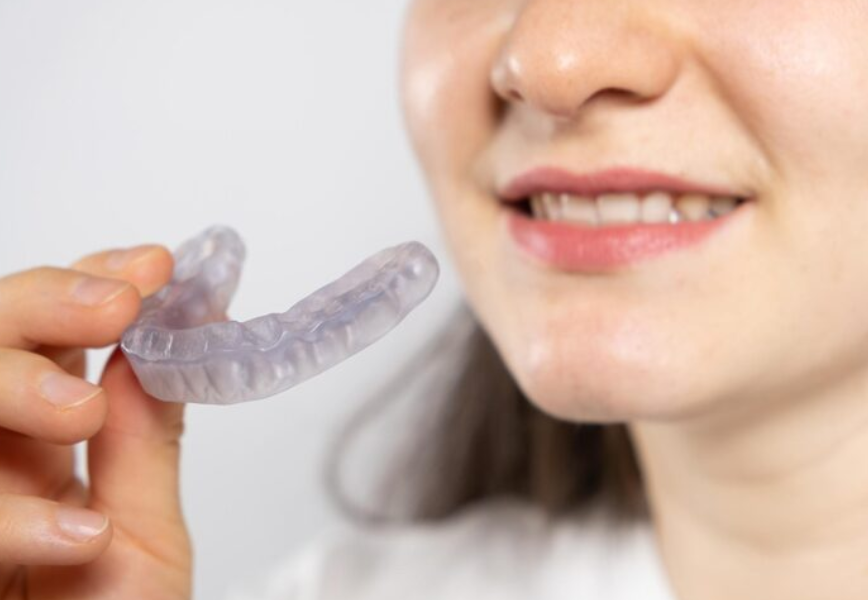
A custom night guard has one specification most people never think to ask about, and it decides more about the outcome than the material name does. Thickness determines how much force the guard can absorb before it wears through, and it also determines how likely you are to keep it in your mouth all night. Those two pull in opposite directions. Thicker protects longer and feels more intrusive. Thinner disappears and wears out sooner. Getting the balance right for your own grinding is what separates a guard that lasts years from one that fails in a season.
What Thickness Actually Means
Night guards are usually described in millimeters, and the range runs from around one millimeter at the thin end to four millimeters or more at the heavy end.
The number refers to the material between your upper and lower teeth once the guard is seated. That is the layer taking the grinding force, and it is also the layer separating your jaws slightly further apart than they normally rest.
Most people never see this figure because drugstore guards do not publish it and many providers do not volunteer it. Asking is reasonable, and a provider who can answer is one who is building to a specification rather than to a template.
Why Thicker Is Not Automatically Better
The Wear Argument
The case for thickness is straightforward. More material means more to grind through before the guard reaches your teeth. A heavy grinder in a thin guard can wear a hole in months, and a guard with a hole in it has stopped working at that spot entirely.
The Compliance Problem
The case against is equally real. A thick guard holds your jaw further open, which some people find uncomfortable enough that they push it out during sleep without waking.
A guard on the pillow at three in the morning protects nothing. This is the failure people underestimate, because it does not look like a failure. The guard is intact, it fits, and it spent half the night out of your mouth.
The Jaw Position Question
Opening the jaw beyond a small amount also changes muscle position. For most people this is unremarkable. For anyone with existing jaw joint symptoms, it is worth raising with a dentist rather than assuming more material is safer.
Working Out How Hard You Grind
Your own history answers this better than any test.
If you have worn through a drugstore guard, you are at the heavier end and thin material will not serve you. If a dentist has pointed out flattened biting surfaces, chipped edges, or wear facets on your back teeth, the same applies.
If you have never damaged a guard, have no visible wear, and your grinding was picked up from a partner hearing it occasionally, you are likely at the lighter end.
New sensitivity to cold or sweet things sits in between and is worth mentioning at your next exam, since it suggests enamel has thinned somewhere.
Matching Thickness to Grinding
Light grinders generally do well with thinner guards, roughly one to two millimeters. The material lasts adequately at that level of force, and the low profile makes the guard easy to sleep in.
Moderate grinders are usually best served around two to three millimeters, which is also where most dual-laminate builds sit. That combination gives a soft inner surface for comfort with a firm outer layer to take the wear.
Heavy grinders need three millimeters or more, and generally need hard acrylic rather than soft material, since soft material at any thickness gets chewed rather than resisting.
These are starting points rather than rules. Someone with a strong gag reflex may need to accept thinner material and replace it more often, and that trade is a reasonable one to make deliberately.
Where Fit Matters More Than Thickness
A guard formed over a model of your own arch follows the contour of every tooth. That close contact is what holds it in place, and it also lets a thinner guard perform better than a thicker loose one.
This is the practical reason custom guards outperform drugstore versions at every thickness. A boil-and-bite guard compensates for a rough fit with bulk, which is why they feel large and why they fall out.
Labs producing from home impressions work the same way clinical labs do. FixUrSmile builds guards over a stone model poured from an impression you take yourself, which is the same fabrication route a dental practice would have outsourced anyway. The impression is the step that determines how closely the finished guard follows your teeth, so it is worth taking slowly.
Signs You Chose Wrong
Too Thin
Look for thin patches when you hold the guard to a light, and check the edges for wear. A guard that develops a hole within the first year was under-specified for your grinding.
Too Thick
Waking with the guard out, waking because of it, or persistent excess salivation past the first month all point toward bulk your mouth is not accepting.
Jaw soreness that started when you began wearing the guard, rather than easing, is worth taking seriously as well.
Either Way, It Is Fixable
Neither situation means guards do not work for you. It means the specification needs adjusting on the next one, and knowing which direction to move is most of the problem solved.
Making the Choice Practically
Start from your own wear history rather than from a product description. Match thickness to how hard you actually grind, then choose material to match, then prioritize fit above both.
Check the guard monthly under good light and be honest about how many nights it stayed in. Those two habits tell you within a few months if the specification was right, which is soon enough to correct it before your enamel pays for the mistake.
Enamel does not grow back, so the cost of getting this wrong is measured in crowns later rather than in the price of another guard now.